How much is enough?
It sounds like a simple question.
But watch what happens when you actually try to answer it.
How much money would be enough?
How big a house?
How much success?
How much recognition?
How many possessions?
How many followers?
How much influence?
At what point would the human mind simply say:
Enough. I have everything I need.
For most people, there seems to be no obvious answer.
There is always more.
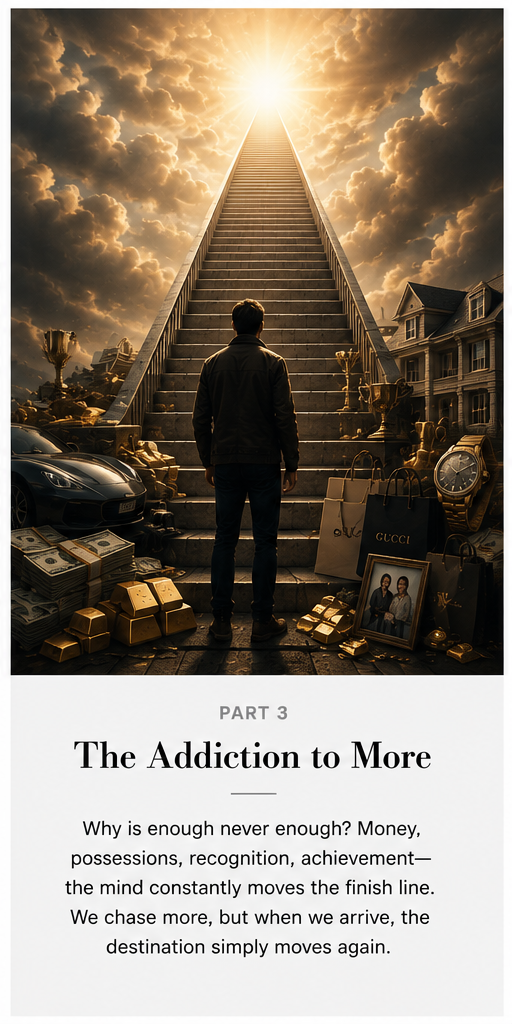
And perhaps that is one of the great addictions of our species.
The finish line that moves
When I was younger, I assumed that happiness was somewhere ahead.
I think many people do.
When I have more money…
When I get that house…
When I get that job…
When I meet the right person…
When I achieve this…
When I achieve that…
Then I will be happy.
But there is a problem with this way of thinking.
When we eventually arrive, the mind gets used to it.
What once seemed extraordinary becomes normal.
And then something else becomes the new destination.
The finish line moves.
Again.
And again.
And again.
Perhaps the mind is not particularly interested in happiness.
Perhaps it is interested in pursuit.
The endless appetite
Look at modern civilisation.
We are surrounded by more than any previous generation in human history.
More entertainment.
More information.
More food.
More technology.
More possessions.
More choice.
More convenience.
And yet anxiety, dissatisfaction and restlessness remain deeply woven into modern life.
We have created a world capable of satisfying almost every physical desire, but the mind simply creates new ones.
There is always another thing to buy.
Another place to visit.
Another achievement to chase.
Another person to impress.
Another version of ourselves to construct.
The market understands this perfectly.
It doesn’t need you to be satisfied.
It needs you to want.
And so we are constantly presented with messages telling us, directly or indirectly:
You are not quite enough.
Your house could be better.
Your body could be better.
Your clothes could be better.
Your car could be better.
Your career could be better.
Your life could be better.
And fortunately, there is something you can buy that will supposedly fix it.
For a while.
Then something else will be needed.
The strange economics of desire
The entire system works beautifully when viewed from the perspective of desire.
Desire creates consumption.
Consumption creates economic activity.
Economic activity creates growth.
Growth creates more desire.
And around we go.
There is nothing inherently wrong with any of this.
Human beings need things.
Society needs functioning economies.
People need homes, food, medicine, transport and countless other necessities.
The question is where necessity ends and psychological hunger begins.
When does I need this become I need to have more than I currently have?
When does comfort become excess?
When does ambition become obsession?
When does success become a substitute for meaning?
These aren’t easy questions.
And perhaps there are no universal answers.
But they are worth asking.
What are we actually accumulating?
There is another irony that interests me.
We spend enormous amounts of our lives accumulating things.
And yet the one thing we can never accumulate is time.
Money can be replaced.
Possessions can be replaced.
Careers can be rebuilt.
Reputations can sometimes be rebuilt.
Time cannot.
Every day that passes is gone permanently.
And yet we often exchange enormous quantities of our limited time for things that we eventually leave behind.
We work to buy things.
We buy things to make ourselves comfortable.
We become comfortable and then want more.
So we work more.
And eventually we look back and realise that we have spent a significant portion of our lives pursuing objects that never possessed the meaning we originally assigned to them.
Perhaps this is one of the great tricks of the human mind.
It convinces us that the thing we don’t have is more valuable than the moment we are actually living.
The possibility of enough
There is something quietly radical about deciding that enough is enough.
Not because you have given up.
Not because you are incapable of achieving more.
But because you have finally realised that more and better are not necessarily the same thing.
There is freedom in needing less.
Freedom in caring less about status.
Freedom in not constantly comparing yourself with other people.
Freedom in realising that you don’t need to impress anyone.
Freedom in understanding that possessions are things you own — not things that should own you.
Perhaps this is part of what I mean when I talk about escaping the matrix.
I don’t mean disappearing from society.
I mean becoming less psychologically dependent upon the things society tells you that you should want.
Because once you stop needing the approval, the status, the possessions and the endless accumulation…
something interesting happens.
You become harder to control.
The quiet life
Maybe that is why I have increasingly found myself drawn towards simplicity.
Not because I believe the world is entirely wrong.
Not because I believe I have somehow discovered all the answers.
But because I have become increasingly suspicious of the idea that happiness lies somewhere in the next acquisition.
The next achievement.
The next distraction.
The next version of myself.
Perhaps happiness is not something waiting for us at the end of the road.
Perhaps it becomes possible when we stop running.
And perhaps the most uncomfortable question we can ask ourselves is also the simplest:
If I stopped wanting more, would what I already have finally be enough?
I don’t know.
I’m still exploring that question myself.
But after fifty years of watching the human race chase more, I have begun to wonder whether the real freedom might be found in wanting less.
And perhaps that is where the journey begins.