There is something I have increasingly come to question as I have moved through life.
How much of the world do we actually experience as it is?
And how much of it is simply the version our minds allow us to experience?
We move through life believing that we see reality.
We see the sky. We see trees. We see buildings. We see other people. We hear sounds, feel sensations, smell things, taste things.
It all feels completely real.
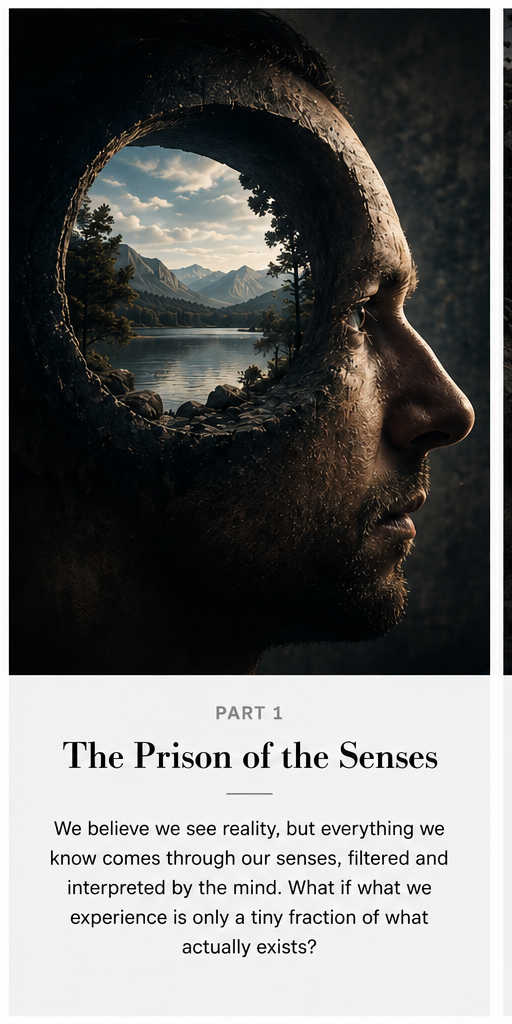
But our experience of the world is entirely dependent upon our senses.
Our eyes detect a tiny fraction of the electromagnetic spectrum.
Our ears detect only a limited range of frequencies.
There are sounds we cannot hear, wavelengths we cannot see and phenomena we cannot perceive at all.
Other creatures experience the same world very differently.
A dog walks through a park experiencing a world dominated by smells that are almost invisible to us.
A bat navigates through sound.
Some animals can detect magnetic fields.
What we call reality is therefore, at least partly, the particular version of reality that our biological machinery allows us to perceive.
And then the mind takes all of this information and constructs a picture.
We don’t simply see.
We interpret.
We don’t simply hear.
We assign meaning.
And somewhere along the way, we begin to mistake that interpretation for reality itself.
Perhaps that is where the trouble begins.
The world we construct
Consider something as simple as money.
A piece of paper has no inherent value.
A number appearing on a bank account has no physical substance.
And yet entire societies are organised around it.
People work for it.
People fight over it.
People sacrifice their time for it.
People measure their success by it.
People become terrified of losing it.
The same is true of status.
A title.
A position.
A reputation.
A number of followers.
A particular car.
A particular house.
None of these things have intrinsic meaning.
We give them meaning.
The human mind creates a story around them and then behaves as though the story were absolute reality.
Perhaps this is one of the strangest characteristics of our species.
We create invisible concepts and then become prisoners of them.
We create borders and then kill over them.
We create political identities and then hate people who belong to another one.
We create social hierarchies and then spend our lives trying to climb them.
We create possessions and then spend our lives protecting them.
We create ideas about who we are and then become defensive whenever someone challenges them.
The mind builds the cage.
Then spends the rest of its existence defending the cage.
The strange thing about being human
I don’t think this makes humanity evil.
I think it makes humanity profoundly immature.
We have become extraordinarily capable without necessarily becoming extraordinarily conscious.
We have developed machines capable of incredible things.
We can communicate instantly across the planet.
We can look into distant galaxies.
We can manipulate the smallest building blocks of matter.
And yet the human being remains remarkably attached to ancient concerns.
Who has more?
Who has less?
Who is winning?
Who is losing?
Who is above me?
Who is beneath me?
Who belongs to my group?
Who doesn’t?
We have changed our surroundings enormously.
But perhaps we haven’t changed ourselves nearly as much.
That thought has stayed with me.
Because perhaps the real limitation isn’t the world around us.
Perhaps it is the mind through which we experience it.
Looking beyond the obvious
I don’t claim to know what exists beyond our perception.
Nobody does.
And that, strangely enough, is part of the point.
We are incredibly confident about a reality that we experience through a tiny biological window.
Perhaps there is far more to existence than we are capable of perceiving.
Perhaps there isn’t.
But I think there is value in admitting that we simply don’t know.
That admission requires something the human mind doesn’t particularly enjoy:
Humility.
And perhaps humility is where genuine curiosity begins.
The older I become, the less interested I am in pretending to have all the answers.
I am increasingly interested in observing.
Watching the mind.
Watching people.
Watching civilisation.
Watching the endless drama of human existence.
And wondering how much of what we consider to be reality is actually reality…
and how much is simply the story our minds have constructed around it.
Perhaps escaping the matrix begins there.
Not by leaving the world.
But by questioning the way we see it.