One of the strangest things about being human is that we live in a world that has changed almost beyond recognition while carrying essentially the same mind that our ancestors carried thousands of years ago.
The environment has changed.
The technology has changed.
The buildings have changed.
The way we communicate has changed.
But underneath it all, the human animal remains remarkably familiar.
We still fear.
We still compete.
We still seek status.
We still form tribes.
We still want power.
We still want more.
And perhaps most importantly, we still struggle to control the world around us.
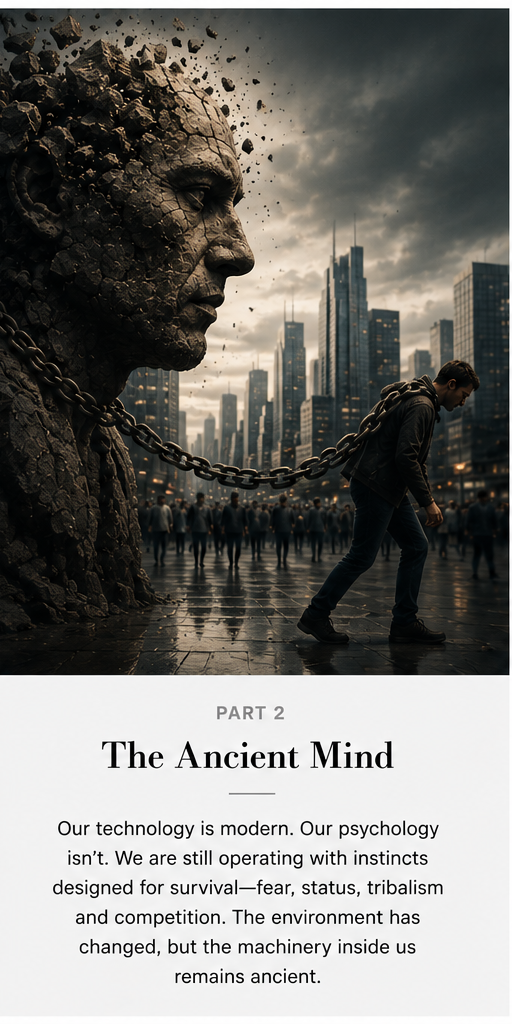
Our technology may be modern.
Our psychology is ancient.
A mind built for survival
The human mind was not originally designed to make us happy.
It was designed to keep us alive.
Fear had a purpose.
Suspicion had a purpose.
Aggression had a purpose.
Competition had a purpose.
Knowing who belonged to your group and who didn’t could mean the difference between life and death.
Finding food mattered.
Protecting territory mattered.
Knowing your position within the group mattered.
These instincts were useful.
They helped us survive.
But the environment changed much faster than the machinery inside our heads.
Today, most of us don’t need to hunt for our dinner.
We don’t need to defend ourselves from predators.
We don’t need to fight another tribe over access to a river.
And yet the underlying psychology remains.
The threats have simply changed.
The predator has become the mortgage.
The tribe has become the political party.
The competition has become the workplace.
The territory has become the house.
The status hierarchy has become social media.
The ancient instincts have simply found modern environments in which to express themselves.
The need to win
Look at how much human behaviour revolves around winning.
We want to be right.
We want to be respected.
We want to be admired.
We want to be richer.
We want to be more successful.
We want to be more attractive.
We want more followers.
We want a better position.
We want our children to outperform somebody else’s children.
We compare.
Constantly.
And comparison is one of the great engines of human dissatisfaction.
Because there is almost always somebody above us.
Somebody richer.
Somebody more successful.
Somebody younger.
Somebody more attractive.
Somebody with a bigger house.
Somebody with a better car.
Somebody with more influence.
The mind sees this and says:
More.
And so we chase.
We spend years chasing things that we believe will finally make us feel secure.
But when we reach them, the mind simply moves the destination.
There is always another mountain.
Another achievement.
Another possession.
Another target.
The ancient mind is never quite finished.
Power and control
Perhaps the deepest expression of this ancient machinery is the desire for control.
We want to control our circumstances.
We want to control our relationships.
We want to control how other people see us.
We want to control the future.
We want to control outcomes.
And when we can’t control something, we experience fear.
The problem is that reality doesn’t operate according to our wishes.
People change.
Relationships end.
Money disappears.
Bodies age.
Plans fail.
People die.
Life happens.
The mind hates uncertainty, so it attempts to construct a world in which uncertainty can be minimised.
We build systems.
We build rules.
We build institutions.
We build identities.
We build walls.
We accumulate possessions.
We accumulate money.
We accumulate influence.
All in an attempt to feel that we have some control over the chaos.
But eventually reality reminds us that we never had as much control as we thought.
Have we actually evolved?
This is where I find myself questioning the idea of human progress.
Certainly, we have progressed technologically.
There is no denying that.
But is technological advancement the same thing as evolution?
I don’t think it necessarily is.
We can build artificial intelligence and still behave irrationally.
We can communicate instantly across the world and still hate people we have never met.
We can split atoms and still wage wars.
We can travel into space and still be obsessed with status.
We can possess extraordinary knowledge while remaining remarkably ignorant of ourselves.
Perhaps our greatest challenge isn’t discovering more about the universe.
Perhaps it is discovering more about the creature looking at it.
Because until we understand the machinery of our own minds, every technological advance simply gives an ancient mind more powerful tools.
And that thought is both fascinating and frightening.
A primitive mind with primitive tools can cause limited damage.
A primitive mind with extraordinary technology is something else entirely.
Watching the machinery
Perhaps evolution, in the deepest sense, begins when the human being becomes capable of observing the machinery inside themselves.
To notice anger without becoming angry.
To notice fear without immediately obeying it.
To notice greed without feeding it.
To notice the desire for status.
To notice the need to be right.
To notice the desire for control.
And simply ask:
Why?
Why do I need this?
Why does this matter?
Why am I afraid of losing it?
Why do I need this person to agree with me?
Why do I need to be recognised?
Why is more always better?
Perhaps that questioning is the beginning of something.
A small distance between the person and the mind.
A moment in which the machinery is visible.
And once you can see the machinery, perhaps you don’t have to obey it quite so blindly.
Maybe that is what evolution actually looks like.
Not becoming more powerful.
Becoming more aware of the power that already exists inside us.
Because perhaps humanity’s greatest unfinished journey isn’t outward.
It is inward.